Wazup Global Airport, Train & Cruise Port Transportation






Global Transportation Service
Bologna to Ravenna Cruise Port: Why Tour Operators Outsource Ground Transfers
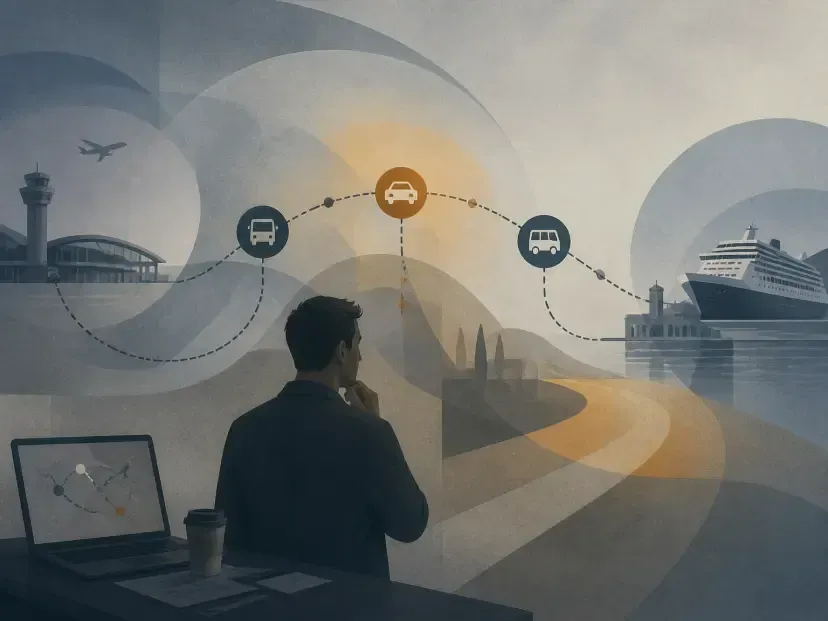
Every cruise package lives or dies on its ground logistics, and nowhere is that pressure more acute than the Bologna to Ravenna cruise port corridor. Tour operators who assume this transfer is straightforward quickly discover a route that demands precise timing, multimodal coordination, and contingency planning that most standard arrangements simply cannot support.
The stakes are high. A typical 8 AM disembarkation in Ravenna leaves a narrow 3 to 4 hour window before mid-day flights depart Bologna airport, and Royal Caribbean offers no direct transfer support for this route. That gap lands squarely on your shoulders as the operator.
This analysis breaks down exactly why this corridor catches even experienced operators off guard, where multimodal routing fails under real-world conditions, and what a failed transfer costs your package reputation. You will also find a clear case for why outsourcing to a dedicated provider is not just convenient but strategically sound, particularly during peak season when every risk compounds. If you are building or refining transfer arrangements for passengers moving through this region, the sections ahead give you the operational clarity to make the right call before your passengers ever arrive.
Why the Bologna to Ravenna Corridor Catches Operators Off Guard
Bologna Guglielmo Marconi Airport (BLQ) and Ravenna's cruise terminals are connected by an approximately 75-minute road journey, but no single shuttle or cruise line transfer covers the full route. Operators must assemble multiple legs independently, creating a coordination burden before passengers have cleared the port.
Ravenna is a less prominent cruise hub than Civitavecchia or Venice, and its ground transfer options reflect that status. A scheduled shuttle runs between Bologna Airport and Ravenna Railway Station, but it terminates at the station, not the cruise terminal. That final leg still requires a separate taxi, so operators cannot treat the shuttle as a complete solution.
The service gap is sharpest at the cruise line level. Royal Caribbean, one of the primary operators docking at Ravenna, does not offer a transfer to Bologna; its only organised ground transfer routes passengers to Venice instead. Operators handling Bologna-bound passengers must fill that gap themselves. A private transfer from Bologna Airport to Ravenna cruise port is the most reliable way to close it, though many operators only recognise this after committing to an itinerary.
Each handoff along the standard DIY routing is individually manageable; collectively the legs form a chain with no margin when timing is tight. Operators running transfers between Venice and Ravenna cruise port for split-routing groups face an added coordination layer that multimodal public transit cannot absorb.
These friction points typically surface only once passengers are already moving, at which point options narrow considerably.
The 3-4 Hour Window: Breaking Down the Timing Math
That multimodal complexity has a time dimension that makes it genuinely unforgiving, and the numbers tell the story clearly.
A cruise arriving at Ravenna at 6 am will not begin disembarkation until approximately 8 am, compressing every subsequent transfer step into a mid-morning window with no flexibility to spare. For passengers catching a 1 pm departure from Bologna Guglielmo Marconi, the total available window spans roughly three to four hours, covering port exit, the transfer to Ravenna station, the rail journey, and airport check-in.
Regional trains on the Ravenna to Bologna route run approximately hourly. Reported departures at 8:43 am and 9:43 am illustrate the schedule's structure, and the practical realities of navigating this journey from Bologna airport to Ravenna cruise port confirm why timing matters so acutely: a missed train costs a full 60 minutes with no realistic recovery option.
The rail journey itself runs just over one hour, which means a passenger boarding at 9:43 am arrives in Bologna at approximately 10:45 am. With the standard recommended two-hour pre-departure window, they are already cutting it fine for an 11 am airside deadline, and that calculation assumes zero delay at any earlier step.
Working backwards makes the constraint even sharper. A 1 pm Bologna departure requires the passenger to be airside by 11 am, which means boarding a Ravenna train by 9:45 am at the absolute latest. That leaves fewer than two hours after disembarkation to exit the port, arrange onward transport, and reach the platform.
Every minute of that window is consumed by a chain of separate legs, each dependent on the last.
The real problem is not any single step; it is the absence of any meaningful buffer across all of them combined.
Multimodal Routing and Where It Breaks Down
The routing architecture itself is what makes the timing so unforgiving.
Taxi availability at Ravenna's cruise terminal is the first fragile link. During August, when multiple ships may disembark on the same morning, competing passenger groups converge on the same small rank simultaneously. There is no guaranteed supply to meet that concentrated demand.
The rail leg introduces a risk category entirely outside anyone's control. Italian rail strikes are not anomalies; Trenitalia's own guidance on strike disruptions treats them as a standing operational category. A July 2026 nationwide strike disrupted services across multiple operators simultaneously, with minimum service protections applying only during peak commuter hours. Cruise disembarkation sits outside those protected windows.
Luggage compounds every transfer. Passengers on multi-week sailings travel with substantial bags. Navigating station stairs, train carriages, and tram stops under time pressure with large luggage materially increases the probability of a missed connection.
Experienced travellers have already reached this conclusion independently. A Rick Steves forum thread recommended a private driver as an alternative to the multimodal chain, illustrating why experienced travellers reach the same conclusion independently. The barrier identified is not cost; it is the absence of vetted providers, explored further in this analysis of why private transport wins on the Bologna to Ravenna route.
Four sequential dependencies within a 3-to-4-hour window produce an aggregate risk profile materially worse than any single step implies. One failure anywhere in the chain means the whole sequence fails.
What a Failed Transfer Means for Your Package Reputation
Those aggregate failure risks do not remain abstract once a disruption actually occurs. The ground transfer is frequently the last interaction a passenger has with your package before boarding their flight home, which means it carries disproportionate weight in how the entire trip is remembered and reviewed.
When a passenger misses a flight due to a transfer breakdown, they do not apportion blame between the cruise line, the ground provider, and the tour operator. In their perception, the operator owns the experience end to end. That attribution is commercially consequential, not merely unfair.
The direct financial exposures are immediate: flight rebooking fees, overnight accommodation for stranded passengers, and missed connections that cascade into further costs. These liabilities materialise specifically when transfer arrangements lack guaranteed delivery windows, which is precisely what multimodal, self-assembled routing cannot provide.
The reputational exposure compounds over time. Research analysing cruise passenger satisfaction confirms that off-board logistics are among the primary drivers of both satisfaction and dissatisfaction. End-of-journey reviews carry particular weight with prospective buyers, who reasonably treat a final-stage failure as a signal of how an operator manages the full package. A logistics complaint posted at the end of an otherwise positive trip can suppress conversion rates in ways that a mid-cruise service issue rarely does.
During August, when cruise transfers between Bologna airport and Ravenna port are under maximum pressure, social media sharing and review velocity both peak. A single high-profile group failure during this window can reach a wide audience of future passengers before the operator has any opportunity to respond.
Operators who have mentally filed this transfer as resolved are the most exposed. Treating it as an active logistics risk is not overcaution; it is the baseline competence the market now expects.
The Case for Outsourcing: What a Dedicated Transfer Provider Solves
The risk is clear. The solution is structural.
A single door-to-door vehicle service removes the failure modes rather than managing them, replacing every multimodal handoff point in one decision.
Timing is equally resolved. Professional transfer services schedule vehicle dispatch against confirmed disembarkation windows, so the driver is at the terminal when passengers walk out, not summoned on arrival. Pre-positioned transport on this corridor is not a premium feature; it is the operational baseline.
Beyond the operational dimension, the contractual one matters equally. Vetted providers can be held to defined service levels written into operator agreements, which creates a clear escalation path if disruption does occur and a defensible position with passengers. That accountability structure does not exist with ad hoc taxi bookings or public rail.
Multi-destination groups are also accommodated without rebuilding the entire routing. Passengers splitting to Bologna, Venice, or elsewhere post-disembarkation each receive a distinct, confirmed vehicle assignment, independent of one another.
Wazup.com's airport and cruise transfer network covers this corridor with bookable, professional vehicle services, giving operators a single point of contact for the full routing rather than coordinating across separate taxi firms, rail timetables, and onward connections independently.
Peak Season Amplifies Every Risk: What August Means for This Route
The risks outlined above do not distribute evenly across the calendar. August concentrates them.
On turnaround days, the terminal simultaneously processes thousands of arriving and departing passengers, compressing taxi and shuttle capacity at the precise moment demand peaks. Arrangements that work comfortably in April become unreliable at precisely the moment an operator needs them most.
The regional train to Bologna is not immune to this pressure. Summer increases occupancy on an already-constrained service, and passengers travelling with substantial cruise luggage face genuine difficulty completing a time-critical journey on a crowded train without incident. A standing-room carriage is an uncomfortable experience at any time; during a 3-4 hour transfer window before a mid-day flight, it is an operational liability.
Pre-booked dedicated transfers provide insulation that no on-demand option can match. Capacity is confirmed in advance, before August demand absorbs available vehicles. There is also a contingency dimension that public transport structurally cannot offer: when disembarkation runs late, a dedicated driver waits. A regional train departs on schedule regardless.
Operators planning their step-by-step arrival and departure logistics for Ravenna cruise port should treat confirmed transfer arrangements as a pre-season task, not a detail to resolve once passengers are already travelling.
The highest-leverage decision on this corridor is a simple one: lock arrangements before August, not during it.
Practical Routing Scenarios Tour Operators Need to Plan For
Peak season pressure sheds light on capacity risk, but the underlying logistics challenge exists across every departure window. The four scenarios below represent the distinct planning problems operators encounter on this corridor, each demanding a different level of coordination.
Full group transfer, single mid-day departure. This is the highest-stakes configuration. Every passenger must exit the port, reach their vehicle, and depart within the same narrow window after disembarkation. A coordinated fleet deployment, pre-positioned and confirmed, is the only viable approach. There is no margin for stragglers when a shared flight departure anchors the entire operation.
Split routing post-disembarkation. When passengers branch to Bologna, Venice, or other Italian cities after the cruise, a single shared solution stops working. Each routing requires an individually confirmed transfer. Public transit cannot flex across multiple simultaneous destinations without passengers navigating separate bookings under time pressure. Modular private arrangements, each confirmed in advance, are the structural requirement here.
Embarkation day arrivals into Bologna. The timing pressure runs in reverse, but the complexity is identical. Passengers arriving on different flights throughout the day need staggered, confirmed pickups with delivery to Ravenna port before embarkation closes. Navigating the route from Ravenna Port to Bologna Airport (BLQ) illustrates how the same corridor demands equally precise management in both directions.
Overnight or extended stays in Bologna. Airport pickup on one day and port delivery on another creates a dispersed two-leg arrangement that benefits most from a single provider managing continuity across both movements.
Each scenario points to the same conclusion: improvised solutions assembled under time pressure are not a planning strategy for this corridor.
Making the Right Transfer Decision Before Your Passengers Arrive
Each routing scenario mapped in the previous section shares one underlying requirement: the decision must be made before passengers are in transit, not after.
The Bologna to Ravenna corridor sits at the precise boundary between cruise experience and flight departure. Any failure here is immediately visible, directly consequential, and entirely attributable to the operator in the passenger's perception. The timing pressure leaves no meaningful buffer for multimodal coordination errors.
This is not a cost question. Operators who frame the outsourcing decision around transfer pricing are measuring the wrong variable. The relevant calculation is reputational exposure versus contractual certainty. Wazup.com offers a single confirmed service on this corridor, absorbing peak-season capacity pressure and giving operators a contractual service foundation rather than a best-effort public transit arrangement assembled under time pressure.
The practical action points follow directly from the analysis:
- Confirm transfer arrangements before peak season, when August capacity constraints make ad hoc solutions unreliable
- Map every passenger routing scenario your package includes, including split destinations and embarkation-day arrivals
- Select a provider with a verifiable cruise port transfer track record on this specific corridor, not a general taxi aggregator
The operators best positioned on this corridor are those who treat the ground transfer as a core package component, book it accordingly, and carry no exposure into the moment their passengers step off the ship.
Conclusion
The Bologna to Ravenna corridor exposes a gap that catches even experienced tour operators off guard. The core lessons are clear: the 3-4 hour disembarkation window leaves no room for multimodal errors, public transit chains introduce compounding failure points, peak season removes whatever flexibility remained, and the reputational consequences land with the operator.
The decision to outsource is not about saving money. It is about replacing uncertainty with contractual certainty before your passengers ever step off the ship.
Operators who treat ground transfers as a core package commitment, not a logistical afterthought, are the ones who protect their reputation and earn repeat bookings.